
Captain Planet
Goodbye, and thank you Mr. Turner; a memoir excerpt

What would end up being the final work I did for Leva FilmWorks and Warner Home Video, I drove to Georgia to do interviews for a DVD extras set for Gone with the Wind. By this time, MS progression meant I usually used a rollator walking device. It’s sturdier than a cane and looks like a backwards rolling chair.
Things were getting worse. But, after having adjusted my give-a-shit-ness of what others thought with the cane, I boldly rollated forth. For me, it was walk safely or don’t walk.
To my chagrin, several of the interviews took place in two separate suburban Gone with the Wind museums. They were old places and nearly impossible to navigate as a disabled person. Taking in the steep stairs, looking as impassable as scaling a mountain cliff, I wanted to quit. But when I spoke up, the understanding staff shifted furniture, unlocked side doors, and got me through.
What collections they had! Giant premiere posters, hundreds of authentic items used in the movie, and dioramas of the film’s characters in costumes worn on camera. We filmed for hours. I drank coffee to keep my fatigue at bay.
Celebrity-wise, I interviewed Senator Max Cleland and media mogul Ted Turner.
Max was a delight. His apartment walls, adorned with countless fancy framed photos of himself alongside distinguished dignitaries, celebrities, and military generals sparkled like Times Square on New Year’s Eve. And he certainly didn’t let a little thing like having been blown up by a grenade when serving in combat, and losing a few limbs to the explosion, stop him—no siree. This Max fellow went on to spend his life in America’s service, and he was a joyful, nice man.
Max was also quite in-the-know regarding the minutiae of Gone with the Wind. As we set up lights, took room sound, and settled in, Max said, “It’s one of my all-time favorites. I may know every line in the film by heart!”
Then he quoted a few parts (playing all the roles) as if upon a stage. His joy was infectious.
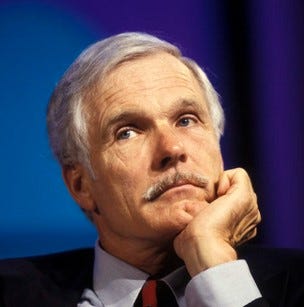
I thought I’d seen every version of toughness a man could display. But then came Ted Turner. This guy was a whole new species: a titan of media, a mercurial mind, and allergic to small talk.
To get to Turner’s metropolis-based lair, I had to navigate through the Tenth Circle of Hell. This is a secret level that Dante fellow neglected to warn anyone about.
And this ring of torment came rushing at me as a hyper-aggressive six-lane, suggested minimum speed of ninety-five miles per hour, tangle of highway.
Compounding my immediate dislike for this Nuevo Gotham locals simply called “downtown Atlanta,” was my lack of more than half an hour of slumber the night before.
The hotel had its only accessible bathroom suite designed so inappropriately that the bed’s headboard literally rested up against the elevator’s loud-as-a-freight train thirteen-floor shaft. Every bang-bosh scrape thumped through my pillow from dusk till dawn.
The night’s noise bath, mixed with the aforementioned jaunt through vehicular hell, meant that by the time I’d captured the elusive parking space near Turner’s monolith, my MS had begun a terribly timed tantrum.
The crew set up while I ran to the bathroom at least four times. My bladder felt an urgent need, and I was terrified I’d wet myself during the shoot. The “bladder issues” experience was on page one, paragraph two, of every pamphlet warning the newly diagnosed. And it chose that day to make its debut into my life!
Turner moseyed in. The man was handsome, with charming, twinkling eyes. A wealthy-from-Montana rancher type of fellow. Casual yet with an undercurrent of “enough of that dang quibbling, let’s get down to business.”
To me, he exuded the aura of a man who rides horses but has someone else saddle them. I saw Ted as a steadfast cohort. That one phone call you made to bail you out at four in the morning. Still, the slight shadow in his eye seemed to warn, should you cross him, you and your descendants would go into his bad book.
As he sat down, we said our hellos wedged in a small conference room crammed with shoot equipment. When I tried to explain the question format to Turner, my explanation was unclear at best, and worse, to Turner it seemed rude.
I thought I’d been clear, informative, and nice, explaining the questions needed to be answered as a statement. None of the inclusion style you see on television. Those answers you hear that start with “well, as you know…” or “like you said…”. I added, “pretend I’m not even here.”
It’s an awkward way of conversing, but it’s how documentary sound bites need to be.
The result was not my best interview; Ted was tight-lipped. It was like extracting molars to get a sentence out of him. I’d say, “Can you talk to me about purchasing the legendary film?” Blank face. “I liked it.” Full stop.
I asked, “Can you talk to me about Scarlett? How she was quite a woman of her times?” Ted drawled, “She was a pip.” I rolled my eyes inwardly at his replies delivered with disinterest, as its Best Film of 1939 Oscar sat gleaming on a shelf behind him. It was a pricey, purloined nugget of his affection for the film. His personal “my precious.” Yet I was getting clipped, bored replies.
Later, while the crew and I ate thirty-five-dollar bison burgers at Ted’s Montana Grille in the building’s lower level, one of the crew explained that Turner’s shortness was my own doing. Through a mouthful of expensive meat, he said, “I knew what you were trying to say. But yeah, it sounded a bit sharp.” Blurry brained with exhaustion, I’m sure he was right.
There had been no prospect of a rescheduling, so I pretended to be fine. Truth was, I’d felt like I was dragging along my carcass in a broken-wheeled barrel.
Ironically, at the end of the interview, after we had torn down all the equipment, I had retrieved my rollator from out of sight in a corner. “I have MS.” Just an offhand comment, a way to excuse the rollator’s sudden appearance.
Turner froze for a beat, then the hardness drained. For the first time all day, I saw not the mogul or the horse-ranch billionaire, but just another man who knew what frailty looked like. His entire demeanor changed. I wondered if I’d shared my situation sooner, would the interview have gone differently?
Driving home, sitting in my car at a rest stop that same night, I shut my eyes and rested my head on the steering wheel in defeat. The struggles of the weekend leached into my marrow until I finally crumbled. I could no longer shoot interviews.
That quick, that was it. The gallivanting was done. My heart hung heavy as an anvil.
My whole life was getting harder, and it was time to stop denying it. I needed to make peace with my small-town newspaper gig. Let that be enough. Max’s joy, Ted’s bluntness, each had their own way of surviving. Mine just happened to come with mandatory adaptations now.
Still, there was life to be found in the smaller things I could still do. Cue Elton, baby: I was still standing. A little crooked or a bit wobbly, and some days there were wheels involved, but I was still (mostly) standing.
🎬 YouTube: @NotThatEmilyBlunt
📸 Instagram:@not_that_emily_blunt
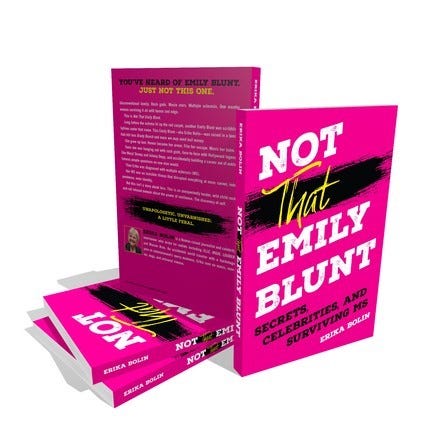
📖 My memoir Not That Emily Blunt: Secrets, Celebrities, and Surviving MS is coming August 2026 more info = erikabolin.com:
You would think that your bosses would just let the person answer the question however they are comfortable then just edit it down! The style required does seem rather cold even annoying. Not your fault at all. Giving up any job you like is always horrible and a total life change. I can't imagine how much harder with M.S.